Showing posts with label body. Show all posts

Sunday, December 19, 2010

Day 348.

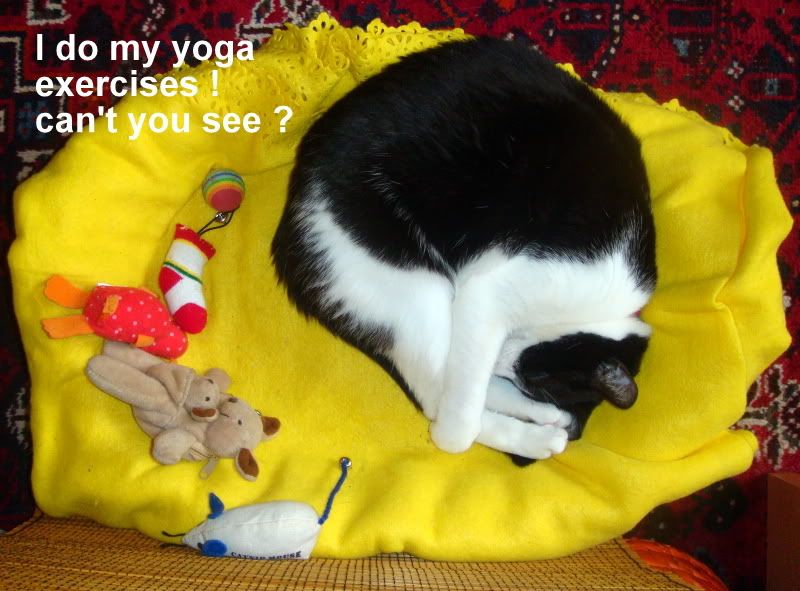
But sadly, I still don't look like this.
In this post, I continue to reflect on this list of questions I posed when I first began this project, 348 days ago.  I asked, after a year of daily yoga practice, will I:
  • Grow a few centimeters in height?
Okay, so to assess whether I grew any in height, I'm employing a highly unscientific method of standing shoeless against a wall, attempting to draw a pencil line in the exact right place at the top of my head, and then using measuring tape to figure the distance from pencil mark to floor. This process is made all the more unscientific by the fact that I didn't measure myself at the beginning of the year.  On my driver's license, it says I'm 5 foot 6 inches tall, but the last time I got measured at the doctor's office proved that I am one of those people who round up to seem taller.  According to the doctor, I was more like 5 foot 5-1/2 inches tall.  ANYWAY, this morning, I measured myself as 5 foot 6-1/8 inches tall.  Hmmm.... Did my pencil mark aim too high?  Was I slouching at the doctor's office?  Or did I grow a little bit?  We'll never know for sure.

Nope, still too short for Splash Mountain!

I also asked, after a year of daily yoga practice, will I:
  • Look different--be slimmer or have more muscle bulk?  Be stronger in my core? Be more stable in my pelvis? Have better posture/alignment? Develop those tiny muscles in my inner hips and the arches of my feet to protect my knees and to help stave off genetic physical ailments? Reduce the frequency of migraines? Improve my circulation? Achieve super healthy blood pressure readings?
Let me start by saying that this here body of mine has served me pretty well during my year of yoga. Yes, I've incurred some injuries. I'm happy to report that none of them have been incurred practicing yoga.  I can't put a value on how many injuries I may have avoided by practicing yoga or staved off "genetic physical ailments," but I know that stretching my limbs and building muscle tone protects me a lot when I do high impact aerobic activities, like running, and even doing little things like getting into my car from a funny angle. The body can get hurt in really small, ridiculous ways.  Trust me, I once re-sprained my ankle trying on a ski boot 

Has my body changed? Of course it has, the body is always changing.  Lately, I feel like my core is kind of weak, but it was super strong in June. It is winter after all, and my body and energy cycles just like the seasons. People have remarked on my fantastic posture over the year, but alignment and keeping my pelvis stabilized seem like things that need lifelong attention and continual adjustments.  I don't know if yoga has helped prevent any migraines, though gentle yoga has been soothing when I've had one.  Circulation?  Sure, while I'm actually practicing, but in general?  Who knows?  And my blood pressure readings, they were pretty dang healthy before this year began, and they still are.


So now for the million-dollar question: do I look different, slimmer or have more muscle bulk?  Honestly.... I think I look pretty much the same as I did last January. My clothing sizes haven't changed. My weight has fluctuated within the same 5-pound window all year. That said, my body has never been in as great shape as it has been at times this year.  Particularly in the spring and summer months.  I definitely am stronger than I was last December, even if my core is a little wimpy at present.

And here's the real triumph: I have never felt so secure with this body as is as I have this year.  And sexy.  This body of mine is strong and sexy and I'm so happy to live in it.  The time I spend every day doing yoga allows me to witness and appreciate my body, while it also puts me in touch with what my body needs and what it likes to keep it healthy and happy.  Even when my muscles burn like crazy from holding a challenging pose, yoga feels like the most incredible gift to my body. 

Maybe I do look different.  Maybe I do stand taller.  Maybe the incredible confidence and respect I've developed for my body on the inside has transformed how I appear on the outside, in ways that have nothing to do with slimness, muscle mass, or the number on the scale. 


Namaste!

Wednesday, September 8, 2010

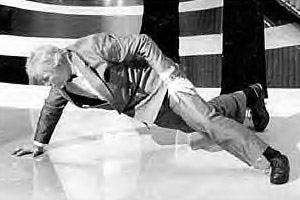
Yes, but can you do that with just one hand?

If only I were as tough as you, Jack Palance....
Over a month has passed since my last blog.  Not only that, but I haven’t been dutifully writing my minutes down on my calendar.  Now don’t panic, I haven’t fallen off my every-day yoga train.  The reason I haven’t been writing down my minutes is simple: for the last month or so, I have done yoga for ~30-35 minutes every single day.  Even stranger, I have done yoga around the same time in the morning on each of those days.

This degree of regularity in my yoga practice was unheard of in my yoga 360 until a month ago.  For the first seven months of this project, I've been consistent in practicing yoga every day, but I sure as hell haven’t been consistent in how much (other than meeting my imposed 30-minute daily minimum) or when I practice.  So what happened to make my yoga practice so dang routine? 

I got hurt.

Really, that’s the reason behind my incredible regular practice.  That’s what it took to turn my daily yoga practice into something as automatic and predictable in my day as getting out of bed.

Now, this isn’t the first time this year I’ve had to work with an injury. But this time I hurt my wrist.  My right wrist.  I hurt it after a long day of digging.  That night, I ached all over, but especially about 2 inches up from my wrist on my forearm.  When I did yoga as usual the next day, it wasn’t too uncomfortable.  But opening jars, washing dishes, using my car’s stick shift, washing my hair, writing, fastening and unfastening my bra and pants, and about a hundred other things...now those things were SERIOUSLY uncomfortable!

I would be holding the baby in this picture, if it didn't make my wrist cry...
“Well, it isn’t broken,” the doctor said when I went in to have my wrist checked out.  “It’s tendinitis of the wrist flexors.”  He strapped a big black Velcro brace on me, told me to take 4 ibuprofen 3 times a day, ice my wrist for 15 minutes three times a day, and to rest it. He told me it could take 2 to 4 weeks for my wrist to heal.  “But I do yoga every day,” I told him.  “Can I at least do downward-facing dog and plank on my forearms?”  To which he gave me a curt "No.”  
No swimming either?!!!  Bending the rules with a Cookie Monster water wing.

And thus came the end of my quest towards 360 days of Adho Mukha Svanasana (that’s Dog pose, yo).  But not my quest towards 360 days of yoga!  When I began this project, I anticipated that I might get hurt and I committed to adapting as necessary to continue my yoga practice.  So when I hurt my wrist, I started adapting.
Tendinitis can't keep me from climbing a mountain, with MY EYES CLOSED!
I couldn’t go to any classes as almost every single yoga class I’ve ever been to has heavily featured downward-facing dog.  Dog is like the complex carbohydrates of a yoga class—substantial and unavoidable in the yoga studio.  But it is possible to omit it from one’s home practice, and all other poses that require any sort of weight bearing on the wrists. So that’s what I did.  No dog, no plank, no cobra, no handstand, no wheel, no crow, no cat and no cow, no, no, and no. I also had be careful and make modifications in other poses like triangle or side-angle pose to make sure I didn’t put much weight on my right hand/arm.

After eliminating those poses from my asana practice, I was left with a lot of standing and balance poses, seated twists, and stretches on my back.  Honestly, during that first week, I found it a little difficult to fill up more than 30 minutes with this limited catalog of poses, which explains my string of 30-to-35-minute-long practices.  I also struggled with boredom; I really missed having all those other poses to toss into my daily mix.  My typical yoga practice does have a degree of order to it, poses I generally do before certain other poses, but there is still a lot of flexibility.  But with my wrist's limitations, I found I did the same poses in more or less the same order (vinyasa) every day.  (Please note that while this is unusual for ME, there are many types of yoga, like Ashtanga, in which one always does the same vinyasa sequence, no matter the class, the instructor, etc.) Maybe this order to my asanas is behind the development of a regular practice time of day in my yoga life; does one routine begets another routine?

I didn’t anticipate a painful wrist injury to bring such stability to my yoga life.  It has been interesting to observe how I’ve responded to a more structured, albeit limited, practice this month.  I’ve enjoyed the additional structure to my day for the most part.  But I really miss classes—sharing the time with other yogis and yoginis, holding poses longer, and being led through different poses I’m not so familiar or comfortable with, etc.

While my wrist is still weak, I’m virtually pain-free and only wearing the brace when I’m doing yoga.  I added dog and plank on my forearms back into my repertoire about ten days ago.  In the last few days, I’ve started pushing into full downward-facing dog.  I often wonder if I’m capable of doing more than I’m allowing myself in my practice. Could I be doing handstand without any issues right now?  But I think there is wisdom in showing restraint, recognizing that I may be more limited from the injury than I notice.  I’m trying to look beyond that 35 minutes on the mat and think about the rest of the month, next month, and beyond!

 Namaste!

Saturday, August 7, 2010

A Funny Thing Happened when I blogged about not blogging....

I expounded so much on one of my coulda-blogged ideas that it became a real, genuine blog post!  I was writing about Judith Hanson Lasater's Letter to the Editor in Yoga Journal.  Let's flashback to that post....

The latest copy of Yoga Journal (YJ) is noteworthy for a few reasons.  It's the 35th anniversary issue of the magazine.  There's a time line of the last 6000 years of yoga history outlined inside.  Sarah McLachlan is on the cover in Utthita Hasta Padangusthasana. And, in the "Letters to the Editor" section, there's a letter from Judith Hanson Lasater (one of YJ's founders and a frequent contributor) expressing her concern about the advertisements featuring naked or half-naked women that have popped up with more frequency in YJ (check out Toesox ads if you want to see what the fuss is about)

Lasater writes, "These pictures do not teach the viewer about yoga practice or themselves. They aren’t even about the celebration of the beauty of the human body or the beauty of the poses, which I support. These ads are just about selling a product."  She goes on to request that YJ stop running ads that exploit the sexuality of young women to sell ad space or magazines.  (You can read more from her letter here.)  As someone who considers herself a feminist and who would NEVER attend a naked yoga class, let me just say, "RIGHT ON, SISTER!"
Nude Toesox model Kathryn Budig, in clothes!
AND then, I kept blogging:

So while looking to see if YJ had a link to this letter online (can't find one if they do), I came across this 35th Anniversary Cover Gallery, where one can look at every cover of YJ over the last 35 years and vote for best covers in four categories.  I started perusing, thinking about the human form, particularly under-dressed (or revealingly dressed) young women.  And I noticed some things.  
OMG, LOOK AT HER BACK FAT!
  •  First, before 1999, YJ didn't always feature a slender, spandex-wearing woman between the ages of 20 and 40 wearing in asana; illustrations and portraits of yoga teachers, noted psychologists and physicians, and spiritual teachers were just as, if not more, often featured on YJ's covers. 
  • Second, I don't think YJ has ever featured an overweight, heavy-set individual in asana on the cover (though the Hammer-style pants that the gal on the July 1983 cover did make me stop to pause).  In fact, there aren't any pictures of pregnant women on any of the covers, which I was sort of shocked by, given the amount of special "health" issues (cancer, AIDS, depression) and "family" issues (midwives, spiritual parenting, masculinity and fatherhood). 
  • Third, the last male shown actually practicing yoga asanas on the YJ cover was on the April 2003 cover
  • Lastly, I noticed that that the last (& maybe only) person with visibly white hair featured actually practicing asana on the YJ cover was John Friend on the December 2002 cover.

You can draw your own conclusions about all that, but me?  It upsets me.  When I go to yoga class, yes, there are a good number of slim, younger women wearing tights and short tops.  But there are also PLENTY of slim, older women in their 40s, 50s, 60s and up, with white hair galore.  And there are certainly men, slim and young, slim and old (though the female to male ratio is still like 6:1).  There are also women and men with big asses, thunder thighs, love handles, arm flab, and beer bellies.  Plenty of that stuff on practitioners of all ages.  

I just want to say that, although the asana practice of yoga IS hard and while many people who practice regularly do have awesome bodies, yoga is accessible for bodies of all shapes and sizes and ages; even the slimmest, prettiest young thing in class has her limitations, poses she can't do because her hamstrings are too tight or she has limited back mobility.   There is a yoga class for everyone, even nudists. 

Just keep your clothes on around me.

Ta-da!  Namaste!

Wednesday, June 2, 2010

On Michael J. Fox and my groin


“The thing about, that I’m always trying to explain to people - because so much of the time, actually, my pills are working and I’m feeling great. And people say, you look so good and you look so smooth, and I have to remind them and myself that when I am smooth and I am - the medication is working, that’s not my natural state.
“My natural state is one that’s affected by the shortage of dopamine production in my brain. So my natural state is to be halting and at times tremulous and kind of just physically disturbed. I mean, that’s my natural state, given the situation in my brain. But I’m always as happy either way.”
 -Actor Michael J. Fox

The above quote comes from an interview on NPR’s Weekend Edition with Scott Simon.  The interview aired in mid-April, on a gusty, rainy Saturday morning in Seattle.  I was eating a light breakfast before a mid-morning yoga class, and I was feeling a little blue.  Then the interview came on the radio.  

There is only so much that a transcript can communicate.  In the interview, just prior to saying the above words, Fox admitted that he was waiting for a pill to kick.  The interview transcript records this.  What the transcript doesn’t convey is that as Fox spoke about the natural state of his brain, his speech was afflicted by the very same halting and tremulous qualities of which he was speaking.  His natural state—that of a man with Parkinson’s disease—was exposed. 
  
Rather than stop the interview until the pill kicked in, Fox chose to continue in spite of the wavering and breaking that riddled his speech.  He chose to acknowledge his natural state, even going as far as to direct the listener’s attention to it.  He fully accepted himself and the limitations of his body in this moment.  It was beautiful and moving to hear.  Maybe it was my mood, the weather, or low blood sugar, but by the end of the interview, I was all teary eyed.

In this modern age of antidepressants, energy drinks, Viagra, and Botox, it is pretty easy to escape the limitations of one’s natural state.  If I’m naturally inclined to snore, I can get some Breathe Right nasal strips to sleep more quietly.  If my all-natural body only fills up an A cup and I want more, I can get breast implants.  I can swallow three or four ibuprofen tablets to keep my muscles from aching after a run, and I can take an Imitrex to get over a migraine NOW instead of waiting it out.  There are pills out there for just about anything to enable us transcend our natural states.

This athlete's natural state doesn't take kindly to Hanumanasana.

I don’t necessarily think there is anything wrong with taking pills or undergoing procedures, etc., that alter one’s natural state, especially when one’s natural state causes pain.  I have a strained groin muscle right now—not only does it cause me physical pain, but it is causing me some emotional pain too.  I can’t enjoy the mood-elevating effects of running because I can’t run; I’m stressed out about how the injury is messing up my half marathon training; and I’m worried I won’t be able to participate in a race for which I’ve put a lot of time, sweat, and heart.  Of course, I’m taking ibuprofen and icing and heating and massaging and doing yoga poses that gently stretch the groin muscles!  I do not like my body’s natural state of achy groin at all.  I want to beat it.

Even with all this ibuprofen and Arnica and Icy Hot treatments and slowly and carefully sitting in Baddha Konasana, I may not be able to beat my achy groin before the race.  My natural state may very well continue to be achy groin for the next twenty-four days.  Maybe longer.  It would probably behoove me to regard my natural achy groin state in a kinder light.  If I accept the limitations of my body, then perhaps I won’t start crying tears of frustration every time I set out on a run and discover that my groin still feels too much pain to proceed.  I suspect that if I cultivate even the smallest amount of acceptance for myself in this injured state, I’m likely to be happier with myself.  I don’t mean to say that by accepting the injury that I won’t continue to down Advil and strap on ice packs—but I find ways to work with it instead of fighting against it.  Sometimes acknowledging one’s limitations can pave the way to new and better means to success. 
 
Hmm, I didn’t really plan to go on and on about my groin pull in this post.  So many other situations and moments I’ve experienced lately have made me think about Fox’s interview—situations that pertained more to my yoga practice and were likely more profound.  Still, my frustration with my groin pain has been acute lately and I thought I needed to work with the problem in my yoga practice OFF the mat as well as on the mat.  I suspect I may write again about Fox’s interview and these questions: What is my natural state and how can I embrace it?  Until then,

May we all learn to accept our imperfections while continuing to aim high with the grace of Michael J. Fox.  
 Relax, Marty.  It's just a groin pull...
 
Namaste!

Tuesday, April 27, 2010

On teachers...

So, I'm going to BEGIN this post with my Yoga Minutes, for days 100-112!  Note my minutes over the first 7 days in particular:
 Grab-ass=not a helpful teaching technique...
4/14: 90 min
4/15: 75 min
4/16: 60 min
4/17: 90 min
4/18: 30 min
4/19: 90 min
4/20: 30 min
4/21: 90 min
4/22: 35 min
4/23: 90 min
4/24: 30 min
4/25: 30 min
4/26: 35 min

So note that on 5 of those first 7 days I did 60 or more minutes of yoga.  Does Jess have a life, you may wonder.  Amazingly, I do, but that's not my point.  What this indicates it that I went to a yoga class on each of those 5 days.  Here's what the numbers don't show: I went to 5 different teachers' classes on those 5 days.    

Yes, this is a lot of yoga, but that's nothing new.  But I don't think I've ever taken classes with so many different yoga teachers in one week before.  Now I take regular, weekly classes with two different teachers (Denise and Wendy) with the occasional Thursday AM with Rainey or Thursday PM with Meg tossed in for good measure.  These are all Anusara yoga teachers and they often take classes from one another, or teach together--frequently, in one week, Denise, Wendy, and Rainey all will give a lot of attention to the relationship between the pelvic loop and the kidney loop (I could explain these.  Really.  But I'm not going to, except to say that they have to do with alignment), but each teacher approaches the loops with different suggestions and uses different poses in which to apply the techniques.  Sometimes, I wish they didn't draw so much inspiration from this tight Anusara yoga community, but generally, I find that the subtle differences in their approach enriches my understanding of the principals being taught.  Generally, I like the crisscross a lot.

Likewise, it is often refreshing to go to a class outside of the Anusara tradition just to remind me of how many different styles of yoga there are, how practicing in a quick-paced flow class feels versus Anusara's slower pace (which does not equate to "easier," FYI), how each style/school of yoga emphasizes slightly different elements/principals, and how each requires a different kind of attention and care while practicing.  I learn a lot every time I practice yoga somewhere new with someone new.

But doesn't taking yoga classes at all these different places suck up a lot of money?  And really, after doing yoga for over a decade, do I really need that much instruction?  An article that ran in the New York Times this past weekend addressed questions such as these. I'll let you peruse the article if you desire, but here's the gist:

The article is about this yoga studio chain called Yoga to the People and its founder, Greg Gumucio.  The studio's mission statement/manifesto on their website proclaims, "There will be no correct clothes, There will be no proper payment, There will be no right answers ... No ego no script no pedestals."  The NYT article continues that there also are "no “glorified” teachers or star yogis. You can’t even find out who is teaching which class when, or reserve a spot with a specific instructor." (itals. mine) 

The seed for Gumucio's studios was first planted when he was studying with Bikram Choudhury, who advised him to take everyone's classes and report back to him.  Gumucio did so and was frustrated by one particular teacher.  Back to the NYT: "Mr. Choudhury was not sympathetic. Just the opposite, telling Mr. Gumucio to, in essence, suck it up and go back to the class — that the problem wasn’t with the instructor, but with Mr. Gumucio himself. “You are your own teacher,” Mr. Gumucio said he was told. “You are responsible for your own experience.”" (itals. mine)

I both respect and cringe at Gumucio's yoga philosophy.  I really like the no egos, no correct clothes, no proper payment attitude, because those are all things that keep people away from yoga who might really benefit from it and ultimately enjoy it. I know I get a little nauseated by yoga show-offs who occasionally come to one of the classes I regularly attend, and proceed to do insane poses with their body that aren't remotely like the poses the rest of us are doing, and of course they're wearing hipster yoga togs and are ripped like He-Man.  And I've put off buying a new yoga mat for 4-6 months now because they are ridiculously expensive.  I spend a TON of money on yoga classes--I don't know exactly how much, but it's definitely a four-figure amount.  I love the idea of yoga for all.

I also agree that you are your own teacher.  If something feels good to me, I'm sorry, but no teacher in the world can tell me that it doesn't.  Or if something hurts me.  I learn a great deal from my body every time I hit the mat.  I don't go to the mat and assume I know what I can and can not do that day.  I have to spend time figuring my body out, like the Sudoku puzzle in the daily newspaper. What's tight today, how tired am I, what does my body tell me now and what will it tell me in 10 minutes?  What challenges are reasonable to take on--which ones might I rock and which ones might be a little disastrous?  If I move in this way, I can bend more that way, but am I strong enough in that place to prevent strain in that spot?

 If I  listen to my body now, will I be able to do this at her age???

So, with all that I learn from my body, do I need to go to these classes?  I guess I don't NEED to, but I feel that I learn more from myself due to how much I learn from my teachers.  Does it have to be Wendy, Denise, and those specific teachers?  I guess not, but they are really good teachers, which means I learn more from them, giving me more to build on at home, so that I can learn more from myself too.  


These thoughts are in regards to where I am with my practice now, however.  This is very important to recognize and consider.  It took me years to build the understanding of my body that I have now.  I could not always tell when something hurt because my muscles were burning in a "good" way, and when something hurt because my body was bending beyond the point of safety and into the zone where muscles get torn and joints dislocated.  I didn't understand how to harmonize my muscles, joints, and bones to bend deeper, or anything about muscle energy and magnetizing my shoulders on my back, etc.  I had to learn the general guidelines and limitations of a reasonably fit human being's body, and I had to learn how to do all those poses, and do them correctly!  

My teachers were invaluable at that point in my practice.  I am so thankful to my first "good" yoga teacher, Jeri at the Moscow Yoga Center in Moscow, Idaho.  My very first two teachers were not good teachers; honestly, they could have been gymnastics or kickboxing instructors for all I learned about yoga from them. Only after I started studying with Jeri did I really start to understand what yoga was all about, and that I liked it.  The right teacher matters a great deal sometimes.

And per "bad teachers," well, they certainly exist.  At this point in my practice, if I run into a teacher who is questionable, I have the knowledge to tune him or her out during a class and just follow my inner teacher based upon the wisdom of my body in the moment.  I absolutely agree with Choudhury that I am responsible for my own experience in such a situation.  I am lucky that my very first teachers were not dangerous in their mediocrity, just not very helpful, and again, I'm so glad I studied with Jeri before I studied with the individual who I refer to as "The Yoga Nazi" because I could recognize that he pushed students in an aggressive way that risked injuries,  in addition to just not being very peaceful!  I wasn't a great student of myself yet, but I'd learned a lot to know when to be cautious.

In closing, I am thankful to my teachers and I am thankful for my body's wisdom and I am thankful for how my practice at home and my practice in class work in symphony together.  When I think of the interplay between the two, I can really understand and appreciate when my different teachers all seem to be teaching the same principal in their separate ways--this is the teacher inside each of them putting their own spin on what they've learned from those who teach them.  Just like I do when I come to my mat at home again and again.

Namaste!

Monday, March 1, 2010

Thinking too much about Savasana

Still doing yoga everyday.  I also officially signed up for that half marathon.  I ran to my office to drop off rent and back yesterday morning--about 5 miles when I include the wrong turn I took which ended up looping back to the confusing intersection in question.  I was TIRED!  And I'm only building from there.

In contrast, my yoga practices have been more and more compact lately (aside from when I go to a studio).  When I first began my yoga 360, I had a really hard time putting together a home practice on my own that lasted 30 minutes.  I did a ton of podcasts at home and sought out classes at studios left and right.  For most of February, though, I've mostly sat down on my mat in silence and created a practice of my own.  Sometimes, I feel like I am not making myself labor enough or sweat enough.  But then again, that isn't the point of this year.  It is about seeing how a regular practice, difficult or not, benefits me and what kind of impact it has on how I approach life.

I will say that I don't find it so hard now to fill up 30 minutes of home practice; I could spend half that time in Savasana, but I don't.  In fact, I still struggle to stay in Savasana for long enough. What is "long enough?"  I read somewhere that a yogi/yogini should reserve at least 1/5 of their practice time for Savasana.  For a 30-minute practice, that breaks down to 6 minutes.  Now my average home Savasana tends to be about 1/15 or 1/10 of my practice time.  Because I know that I have a hard time staying in corpse pose at home, I don't assume that pose until I've been practicing yoga for almost a full half hour.  This is a benefit of classes and podcasts, which include a silent break in the recording for Savasana.  When I follow a podcast, I stay with the recording through the long pause to the point where the instructor rings a bell or uses a bowl to summon the listener out of rest.  Occasionally, I'll set an alarm on my iPhone for Savasana, but this feels like a lot of hassle when I am supposed to be settling into relaxation.

I think my preconceived notions about whether or not I am laboring enough physically in my home practice are at the root of my struggles with abiding in Savasana.  I aspire to question the logic behind these judgments as I continue to practice.  Even if I don't feel my body has worked hard enough to "earn" the reward of Savasana, my mind certainly deserves some relaxation time.  Just look how much overanalyzing it has done in this post!
The author in Adho Mukha Svanasana at home
Not pictured: author's brain in a frenzy over whether camera took the photo or not..

And with that, my minutes for the end of February, Days 47-54:
Feb. 21: 35 minutes
Feb. 22: 90 minutes
Feb. 23: 40 minutes
Feb. 24: 90 minutes
Feb. 25: 75 minutes
Feb 26: 30 minutes
Feb. 27: 40 minutes
Feb. 28: 40 minutes
Namaste!